
Introduction
Ask a dozen people where a machine learning project begins, and you will get a dozen answers. Some say it starts with a business problem, others point to model selection. A growing number recognize it starts with data. However, even among the data-first crowd, a fundamental confusion persists:
Is the starting point data collection or data annotation?
The answer determines not only your project timeline but also whether your model ever actually works in production. This article cuts through the noise to explain exactly where the ML pipeline begins, why the distinction matters, and how to get both stages right.
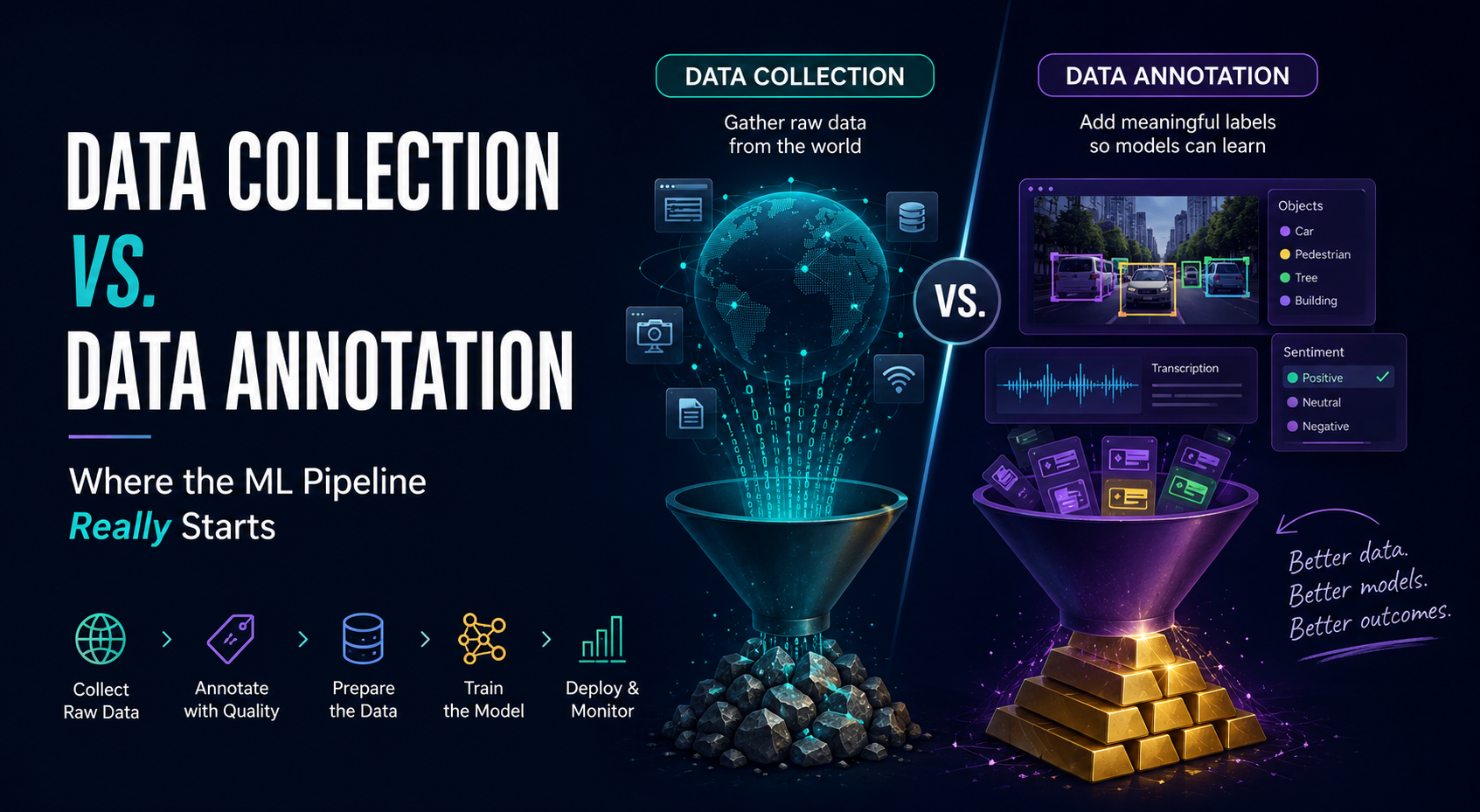
Collecting raw data and annotating it are two separate disciplines with different goals, costs, and failure modes. Data collection is the act of gathering raw material from the world—scraping websites, capturing sensor readings, pulling transaction logs. Data annotation is the act of adding meaningful labels to that raw material so a model can learn from it. Confusing one for the other, or assuming they can be treated as a single step, is the first mistake many teams make. Data collection and curation at scale presents a different class of problem from small-scale annotation work, and quality assurance methods that work for thousands of examples break down at millions.
Think of it this way: data collection is mining the ore; data annotation is refining it into usable metal. You cannot skip either step, but the skills, tools, and quality metrics for each are completely different.
What Is Data Collection, Really?
Data collection is the process of acquiring raw data from various sources to feed into your machine learning pipeline. This might involve web scraping, accessing public datasets, purchasing proprietary data, collecting sensor data from IoT devices, or pulling historical records from internal databases.
The goal is straightforward: gather enough raw material that represents the problem space you are trying to solve.
The Art of Source Selection
Where you source your data shapes everything that follows.
A source selection process that prioritizes easily accessible data over representative data will produce a corpus that is large but systematically skewed toward whatever content those accessible sources contain.
For example, web-crawled text massively over-represents English-language content from educated, English-speaking adults. If your model needs to serve a global audience, that English-centric corpus becomes a structural problem, not a minor inconvenience.
The rise of data-centric AI has made source selection even more consequential. The research community has made significant progress on model architectures over the past decade, and the result is that for most practical AI applications, architecture choices among competitive modern approaches contribute relatively little to the variance in production outcomes.
What contributes most is the data.
The same architecture trained on a carefully curated dataset consistently outperforms the same architecture trained on a noisy one, often by a wider margin than any achievable through architectural modification.
Coverage Planning: Not Just Volume
Too many teams treat data collection as a volume game.
More data equals better model, right?
Not exactly.
Coverage planning means defining the variation space explicitly before data collection begins, then assessing source options against coverage of that space rather than primarily against volume.
For a domain-specific application, this means mapping the target domain’s terminology, use cases, and content types and identifying sources that cover each dimension. For a general-purpose system, it means explicit coverage planning across languages, registers, domains, and demographic perspectives.
The scale at which data collection problems become structural is worth understanding.
- With a thousand examples, a human reviewer can catch most quality issues.
- At a million, systematic automated quality assessment is required.
- At a billion tokens, deduplication becomes a distributed computing problem.
- At a hundred billion, even small systematic biases in the filtering logic can produce measurable skews in model behavior.
Data engineering for AI at scale requires pipeline infrastructure, tooling, and quality standards designed for the target volume from the beginning.
Consent, Licensing, and Provenance
Here is where many teams get into trouble.
Data provenance documentation has moved from a best practice to an operational requirement in most jurisdictions where AI systems are deployed.
Knowing where training data came from, whether it was collected with appropriate consent, and what licensing terms apply is no longer a compliance afterthought.
Programs that cannot document their data provenance face increasing regulatory exposure under the EU AI Act, evolving copyright frameworks, and regulated industry applications where data handling accountability is a direct requirement.
The government of New Zealand emphasizes that improper data collection and processing can mean potential privacy and confidentiality breaches, intellectual property rights violations, and potential data sovereignty and human rights impacts.
Consequences can be:
- reputational;
- financial;
- punitive.
Data Collection vs. Data Annotation
| Data Collection vs. Data Annotation | Data Collection | Data Annotation |
| Primary Goal | Gather raw material from the world | Add labels to raw material for model learning |
| Key Activities | Source selection, web scraping, data acquisition, licensing | Labeling, tagging, quality control, inter-annotator agreement |
| Common Pitfalls | Coverage gaps, bias from source selection, provenance issues | Inconsistency, annotator fatigue, schema creep |
| Cost Drivers | Data acquisition, storage, infrastructure | Human labor, tooling, QA processes |
| Quality Metrics | Representativeness, coverage, legality | Accuracy, consistency, inter-annotator agreement |
What Is Data Annotation, Actually?
Data collection is the process of acquiring raw data from various sources to feed into your machine learning pipeline. This might involve web scraping, accessing public datasets, purchasing proprietary data, collecting sensor data from IoT devices, or pulling historical records from internal databases.
The goal is straightforward: gather enough raw material that represents the problem space you are trying to solve.
The Art of Source Selection
Where you source your data shapes everything that follows.
A source selection process that prioritizes easily accessible data over representative data will produce a corpus that is large but systematically skewed toward whatever content those accessible sources contain.
For example, web-crawled text massively over-represents English-language content from educated, English-speaking adults. If your model needs to serve a global audience, that English-centric corpus becomes a structural problem, not a minor inconvenience.
The rise of data-centric AI has made source selection even more consequential. The research community has made significant progress on model architectures over the past decade, and the result is that for most practical AI applications, architecture choices among competitive modern approaches contribute relatively little to the variance in production outcomes.
What contributes most is the data.
The same architecture trained on a carefully curated dataset consistently outperforms the same architecture trained on a noisy one, often by a wider margin than any achievable through architectural modification.
Coverage Planning: Not Just Volume
Too many teams treat data collection as a volume game.
More data equals better model, right?
Not exactly.
Coverage planning means defining the variation space explicitly before data collection begins, then assessing source options against coverage of that space rather than primarily against volume.
For a domain-specific application, this means mapping the target domain’s terminology, use cases, and content types and identifying sources that cover each dimension. For a general-purpose system, it means explicit coverage planning across languages, registers, domains, and demographic perspectives.
The scale at which data collection problems become structural is worth understanding.
- With a thousand examples, a human reviewer can catch most quality issues.
- At a million, systematic automated quality assessment is required.
- At a billion tokens, deduplication becomes a distributed computing problem.
- At a hundred billion, even small systematic biases in the filtering logic can produce measurable skews in model behavior.
Data engineering for AI at scale requires pipeline infrastructure, tooling, and quality standards designed for the target volume from the beginning.
Consent, Licensing, and Provenance
Here is where many teams get into trouble.
Data provenance documentation has moved from a best practice to an operational requirement in most jurisdictions where AI systems are deployed.
Knowing where training data came from, whether it was collected with appropriate consent, and what licensing terms apply is no longer a compliance afterthought.
Programs that cannot document their data provenance face increasing regulatory exposure under the EU AI Act, evolving copyright frameworks, and regulated industry applications where data handling accountability is a direct requirement.
The government of New Zealand emphasizes that improper data collection and processing can mean potential privacy and confidentiality breaches, intellectual property rights violations, and potential data sovereignty and human rights impacts.
Consequences can be:
- reputational;
- financial;
- punitive.
Data Collection vs. Data Annotation
| Data Collection vs. Data Annotation | Data Collection | Data Annotation |
| Primary Goal | Gather raw material from the world | Add labels to raw material for model learning |
| Key Activities | Source selection, web scraping, data acquisition, licensing | Labeling, tagging, quality control, inter-annotator agreement |
| Common Pitfalls | Coverage gaps, bias from source selection, provenance issues | Inconsistency, annotator fatigue, schema creep |
| Cost Drivers | Data acquisition, storage, infrastructure | Human labor, tooling, QA processes |
| Quality Metrics | Representativeness, coverage, legality | Accuracy, consistency, inter-annotator agreement |
What Is Data Annotation, Actually?
If data collection is mining the ore, data annotation is the refining process. It is the practice of adding descriptive tags or metadata to raw data—drawing bounding boxes around objects in images, transcribing audio, labeling text sentiment, or categorizing product descriptions.
This labeled data is what your model actually learns from.
Roboflow notes that labeled data remains the foundation of production computer vision systems even as foundation models mature, because ground truth quality directly determines model accuracy, compliance readiness, and iteration speed.
The Human Element
At its core, data annotation is a human activity.
Yes, foundation models and synthetic data are changing the landscape, but the ground truth still comes from human judgment.
The cognitive process of labeling is more complex than most people assume. A labeler must understand the prompt, retrieve relevant information, integrate that information, and map it onto the provided answer choices.
At each step, shortcuts can occur—a phenomenon called satisficing.
Social science research on survey methodology offers useful insights here. Just as survey respondents do not always read all response options, labelers may take cognitive shortcuts, especially as task length increases.
This is why annotation guideline quality matters so much.
Guidelines that are specific enough to produce high inter-annotator agreement on borderline cases, and quality assurance processes that measure that agreement systematically, produce a consistent training signal.
Guidelines that leave judgment calls to individual annotators produce data that encodes the variance across those individual judgments as apparent label noise.
Annotation Workflows
Teams today have several annotation workflow options, each with specific trade-offs.
- Manual + Assistive UI
Human annotators do primary labeling using intuitive interfaces and tools to accelerate the process.
This is the gold standard for complex, high-stakes scenarios like medical imaging or legal discovery where precision matters more than speed.
The downside?
High cost
Slow throughput
Annotator fatigue - Model-in-the-Loop
Foundation models pre-label data, and humans refine only the hard samples.
This reduces manual labeling workload significantly—often by three to five times.
The key is confidence-based sampling: only low-confidence examples go to humans. - Synthetic-First
Generate labeled synthetic data at scale, with humans auditing against real samples.
This is ideal for rare events or edge cases but requires careful management of domain adaptation to avoid performance degradation from distribution shifts.
Quality Assurance Metrics for Annotation
Once you start annotating, you need to measure quality.
Here are the key metrics that matter:
- Inter-Annotator Agreement (IAA)
- The degree to which different annotators agree.
- Target at least 0.80 for general computer vision tasks and 0.85 for medical or safety-critical applications.
- If IAA drops, trigger a calibration session or clarify guidelines.
- Golden Set Error Rate
- Maintain a hidden, expertly labeled subset.
- Periodically sample annotators’ work and compute percentage deviation from gold labels.
- More than 2% error?
- Investigate fatigue, unclear schema, or tooling friction.
- Annotation Time per Image
- Track median seconds per image to quantify the return on investment of assistive features.
- Use “seconds per bounding box” as a micro-metric to detect UI bottlenecks.
- Schema Drift
- Monitor class frequencies and definition changes over time.
- Sudden shifts indicate guideline confusion or real distribution change.
Why You Cannot Afford to Confuse the Two
Scenario: Two Teams, One Dataset
Imagine two teams building the same sentiment analysis model.
Team A spends three months collecting two million tweets. They have a huge dataset, but they give annotators vague guidelines about what constitutes “positive” sentiment.
The result?
Low inter-annotator agreement, inconsistent labels, and a model that performs poorly on nuanced examples.
Team B spends three weeks collecting 500,000 tweets from sources carefully selected for coverage across demographics and topics.
They design annotation guidelines iteratively with pilot rounds, measuring inter-annotator agreement and refining the guidelines.
They pay for quality annotation and track metrics like golden set error rate.
The result?
A smaller but cleaner dataset that produces better model performance.
The difference is not just about budget.
It is about recognizing collection and annotation as separate disciplines requiring different investments, skills, and quality metrics.
The Hidden Cost of Getting It Wrong
Poor quality training data does not just cost money—it can lead to mistakes, upset customers, wasted budgets, and damaged business reputation.
Consider the case of BigBuild, a construction firm that deployed an AI CV screening tool trained on historical “successful hire” data.
The data underrepresented women, and the model learned to assess language typically found on men’s CVs as positive while penalizing similar achievements expressed differently on women’s CVs.
The result?
Only three out of ten shortlisted candidates were women despite equal application numbers.
This is a classic data bias problem—not in collection (the data was historically accurate), not in annotation (the labels were correct), but in the source selection during collection.
The model learned historical human bias because the data reflected it.
Fixing it required retraining with more representative, bias-audited data.
The Turing Way emphasizes that the methods for which data is collected, annotated, processed, and shared will impact individuals and communities who may be represented in or the creators of the data.
A machine learning team should consider how the wider community can be involved in data, model, and project governance to empower more people involved in and impacted by the pipeline.
Actionable Strategies for Data Collection and Annotation
For Data Collection
Define your variation space before collecting anything.
Map the dimensions of diversity your model needs to handle:
languages;
demographics;
use cases;
domains.
Document provenance from day one.
Track where each piece of data came from, what license applies, and what consent was obtained.
Plan for deduplication.
At scale, exact duplicates and near-duplicates both harm model quality.
Build deduplication into your pipeline, not as an afterthought.
Consider synthetic data as a supplement.
Use it to fill coverage gaps and augment rare categories, but do not replace human-generated data entirely.
Audit for bias.
Test your data sources for representativeness before training.
A bias found post-deployment is far more expensive to fix.
For Data Annotation
Design guidelines iteratively.
Use pilot annotation rounds to identify ambiguous cases before full-scale collection begins.
Measure inter-annotator agreement.
Track it continuously and trigger calibration sessions when it drops below threshold.
Use golden sets.
A hidden, expertly labeled subset helps you spot quality drift before it ruins your model.
Mix workflows strategically.
Manual annotation for complex cases.
Model-in-the-loop for straightforward ones.
Synthetic generation for rare events.
Combat annotator fatigue.
Shorter shifts, rotating annotators, and periodic calibration tasks maintain quality over time.
