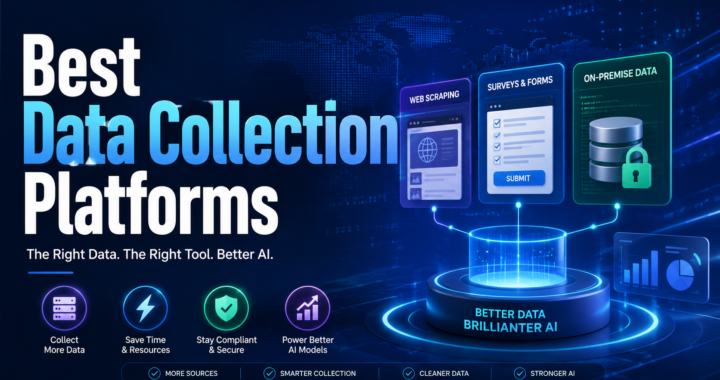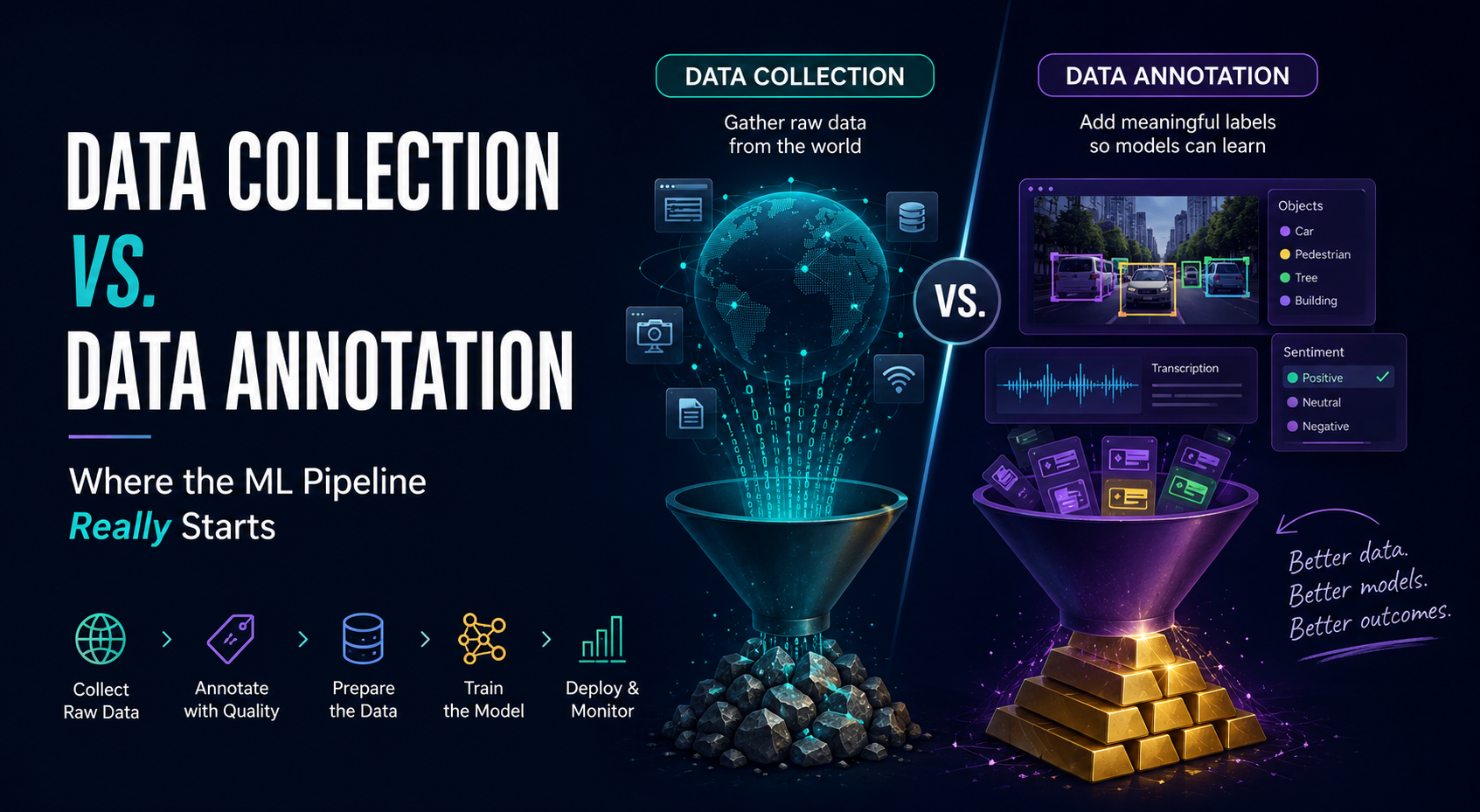
Data is the engine that powers modern AI, but collecting clean, usable data at scale remains a challenge. Whether you’re fine-tuning an LLM, building a recommendation engine, or monitoring competitor pricing, the tool you pick shapes your entire pipeline. Over the past few years, the landscape has split into two clear camps: low-code form builders for surveys and feedback, and heavy-duty scraping platforms for web-scale extraction.
This article cuts through the noise. You’ll learn which data collection tools actually deliver value, how to match them to your use case, and what to look for as AI transforms the field.
The Two Sides of Data Collection
Let’s get this straight from the start: collecting data from a form and collecting data from the web are different jobs requiring different tools.
Form-based tools (Google Forms, Typeform, Jotform) are great for gathering structured input from known sources — customer feedback, event registrations, internal surveys. They’re easy to set up and don’t require technical skills. But they won’t help you extract product prices from Amazon or scrape news articles.

Web scraping and API-based tools (Apify, Bright Data, Oxylabs) handle the opposite end: pulling public data from websites at scale. These are the workhorses for AI training, market research, and competitive intelligence. Most require some technical knowledge, though no-code alternatives are emerging.
Open-source libraries (Scrapy, BeautifulSoup, Playwright) sit in a third category. They’re free and flexible, but you’ll need to manage proxies, handle CAPTCHAs, and maintain your own infrastructure. For teams with engineering bandwidth, they offer maximum control. For everyone else, managed services are worth the cost.
How to Choose the Right Tool
Before diving into specific recommendations, here’s what actually matters when selecting a data collection tool:
- Your technical skill level matters. If you can’t write Python, skip Scrapy and BeautifulSoup. If you’re a developer comfortable with APIs, managed scraping services will feel natural. No-code options exist for everyone else.
- Volume drives cost. Collecting 100 records and 100,000 records are completely different problems. Many tools offer free tiers for testing, but pricing escalates quickly at scale. Check usage limits before committing.
- Anti-bot protection is non-negotiable. Many commercial sites actively block scrapers. If you need data from Amazon, Google, or social platforms, your tool must handle proxy rotation, CAPTCHA solving, and JavaScript rendering. This is where cheap tools fail.
- Data quality impacts everything. Garbage in, garbage out. Look for tools with validation, deduplication, and consistent formatting. Some platforms now include AI assistants to clean and structure extracted data automatically.
Form-Based Data Collection Tools
For surveys, registrations, and feedback collection, these are your best bets.
Google Forms
The simplest option. Free, integrates with Google Sheets, and works for basic data collection. Limited customization and analytics, but perfect for quick projects. Educators, small businesses, and event organizers frequently use it.
Best for: Low-volume surveys, internal feedback, classroom quizzes.
Price: Free.
Typeform
Known for its conversational, one-question-at-a-time interface. Higher completion rates than traditional forms, but advanced features cost money. Good for customer experience surveys and market research.
Best for: Brand-focused surveys, customer feedback, lead generation.
Price: Free tier available; paid plans from $25/month.
Zoho Forms
A solid choice if you’re already in the Zoho ecosystem. Supports conditional logic, offline data collection, and native CRM sync. The free plan is genuinely useful for small teams.
Best for: Business workflows, lead capture, event registrations.
Price: Free tier; paid plans from roughly $7/month.
Jotform
Offers thousands of templates and a drag-and-drop builder. Payment integrations and HIPAA compliance available on higher tiers. Good for businesses needing forms with calculations and document generation.
Best for: Complex forms requiring calculations, payment collection, or compliance.
Price: Free tier; paid plans from $34/month.
Web Scraping and API-Based Data Collection
If you’re collecting data from the public web — and you probably are if you’re training ML models or doing competitive research — these tools dominate the market.
Bright Data
Bright Data offers one of the strongest free tiers on the market: 5,000 credits per month that renew, with no credit card required. Those credits work across their Web Scraping API, SERP API, and Unlocker API. In independent benchmarking, Bright Data achieved a 98.44% average success rate across test sites, the highest result in the evaluation.
The platform includes 437+ pre-built scrapers covering major websites. Failed requests don’t consume credits — you pay only for delivered data. It handles Cloudflare, DataDome, and other anti-bot systems automatically. However, it’s not the cheapest option for simple, unprotected pages.
Best for: Production-grade scraping requiring high success rates and compliance.
Price: Free tier (5,000 credits/month); pay-as-you-go from $1.50/1,000 records; Scale plan $499/month.
Apify
Apify takes a different approach. It’s a marketplace of over 30,000 pre-built “Actors” — self-contained scrapers maintained by developers. If you need data from LinkedIn, Instagram, Amazon, or YouTube, there’s probably an Actor ready to use.
The platform handles infrastructure: proxy rotation, CAPTCHA solving, and scheduling happen automatically. For developers, the Apify SDK (released as the open-source Crawlee library) allows custom builds with high-level helpers for request queues and retries.
Key differentiator: The marketplace model means you can start collecting data in minutes without writing code.
Best for: Teams needing access to diverse data sources quickly.
Price: Free tier ($5 monthly credits); paid plans from $29/month.
Oxylabs
Oxylabs focuses on enterprise-grade scraping with specialized APIs for e-commerce, SERPs, and LLM-generated content. Their Web Scraper API includes OxyCopilot, an AI assistant that helps create scrapers through natural language descriptions.
They also offer AI Studio — a low-code platform where you describe data needs in plain English and the system handles crawling and parsing. This is a significant step toward making web scraping accessible to non-technical users.
Oxylabs’ proxy network includes over 100 million residential IPs, enabling reliable extraction even from heavily protected targets. However, this power comes at a premium price.
Best for: Large enterprises and high-volume extraction requiring reliability.
Price: Starts from $0.50/1K results; enterprise pricing custom.
ScrapingBee
For developers who want a straightforward REST API, ScrapingBee wraps headless Chrome and handles JavaScript rendering automatically. Their one-time free trial provides about 1,000 credits (no credit card required), but there’s no recurring free tier.
Paid plans start at $49/month. It’s a simpler alternative to the heavy-hitters like Bright Data and Oxylabs.
Best for: Developers needing a simple scraping API for moderate volumes.
Price: One-time trial; plans from $49/month.
Open-Source Options
If you have engineering resources and want full control, open-source tools remain viable.
- Scrapy is the Python framework for large-scale scraping. It handles concurrency, retries, and data pipelines out of the box. The learning curve is steep, but it’s free forever and infinitely customizable.
- BeautifulSoup + Requests works well for simple HTML parsing. No JavaScript rendering, no proxy management — you handle everything yourself. Good for small projects and learning.
- Playwright and Puppeteer automate headless browsers. They render JavaScript-heavy pages and can simulate user interactions. Both are free but require you to manage proxies and anti-detection measures.
The global web scraping software market is projected to grow from USD 501.9 million in 2025 to USD 2.03 billion by 2035 — a 15% CAGR.
Free vs. Paid: What’s Actually Free?
Free tiers vary dramatically. Some are genuinely useful for ongoing work; others are just trials.
Recurring free tiers (Bright Data’s 5,000 credits/month, Apify’s $5 monthly credits) allow indefinite testing. One-time trials (ScrapingBee’s ~1,000 credits) expire and don’t renew.
Open-source tools are free in license cost but may require spending on proxies, servers, and engineering time. A tool like Bright Data with a 98% success rate might cost less overall than spending weeks debugging a self-built scraper that gets blocked half the time.
Comparison Table
| Tool | Free Tier | Paid Pricing |
| Bright Data | 5,000 credits/month | From $1.50 / 1,000 records |
| Apify | $5 monthly credits | From $29/month |
| Oxylabs | Trial | From $0.50 / 1K results |
| ScrapingBee | One-time trial | From $49/month |
| Scrapy | Unlimited (self-hosted) | Free |
| Google Forms | Unlimited | Free |
| Octoparse | Limited | From $69/month |
Additional Comparison
| Category | Form Builders | Web Scraping Platforms | Open-Source Libraries |
| Technical Skills Required | Low | Medium | High |
| Best For | Surveys & Forms | Public Web Data | Custom Projects |
| Scalability | Medium | Very High | High |
| Infrastructure Management | None | None | Full responsibility |
| AI/Automation Features | Limited | Advanced | Depends on implementation |
Suggested Graph
Bar chart: Starting Price vs Free Tier Availability
Compare:
- Bright Data
- Apify
- Oxylabs
- ScrapingBee
- Octoparse
Bars = starting monthly price.
Above each bar add labels:
- Recurring Free Tier
- Trial
- No Free Tier
This visually reinforces the section “Free vs Paid” and is much easier to scan than the table alone.
AI Changes Everything
The most interesting development in data collection is AI’s integration into the pipeline. LLMs can now extract structured data from unstructured text, reducing the need for brittle XPath selectors. Tools like Firecrawl use AI to ignore ads, menus, and boilerplate, returning clean JSON from a URL description.
Recent academic work demonstrates end-to-end data collection frameworks that automatically formulate search queries, navigate the web, extract relevant data, and perform quality control. Users remain “in the loop” to inspect and adjust decisions.
This human-in-the-loop approach balances automation with quality assurance.
For research teams, this means less manual data curation and faster dataset creation. For businesses, it means competitive intelligence at lower cost.
Pro tip: When using LLM-based extraction, treat it as part of a pipeline, not the whole solution. Always validate outputs against ground truth samples. AI hallucinates, but good validation catches it.
Practical Recommendations
For students and early-career practitioners starting with data collection, the path depends on your goals.
If you want to collect survey data
Start with Google Forms. It’s free, simple, and teaches the fundamentals of structuring responses. Move to Typeform or Jotform when you need better design or conditional logic.
If you need public web data for a class project
Use Apify’s free tier or Bright Data’s free credits. Both let you test without committing money. Focus on learning what data you need and how to validate quality, not on building infrastructure.
If you’re building an ML product
Invest in a managed scraping service early. Your time is better spent on modeling than on maintaining proxies and handling CAPTCHAs. Bright Data and Oxylabs both offer enterprise-grade reliability and compliance (GDPR, CCPA, ISO 27001).
If you’re a developer comfortable with infrastructure
Scrapy plus a proxy service can be cost-effective at moderate scale. But calculate your hourly rate — if you spend 20 hours debugging a scraper, you could have paid for a year of a managed service.
If you’re in a regulated industry
Prioritize compliance. Look for tools with published security standards. Bright Data holds SOC 2 Type II and ISO 27001 certification; Oxylabs also emphasizes GDPR and CCPA compliance.
Conclusion
The data collection tool landscape has matured. There’s no single “best” tool — the right choice depends on your volume, technical skill, budget, and data source.
Simple form-based tools like Google Forms cover basic needs. For web-scale data, managed scraping services offer reliability and compliance at a price point that makes sense for most businesses. Open-source alternatives remain viable for teams with engineering capacity and simple targets.
The trend is clear: AI is moving into data collection, reducing manual effort and improving extraction quality. Tools that combine easy setup, reliable anti-bot protection, and AI-powered parsing will dominate the coming years.
Don’t overcomplicate your choice. Start with a free tier, test your real use case, and scale when you hit limits. The data matters more than the tool.