Let’s be honest: data is the lifeblood of machine learning, but getting enough of it without breaking the bank is a nightmare. Traditional collections are slow and expensive. That’s where crowdsourced data collection comes in.
This article cuts through the hype to give you a practical framework: the real pros, the hidden cons, and the decision matrix you need to know when crowdsourcing is your solution—and when it’s a trap.
We’ll explore actionable strategies from real-world applications—from mapping conflict zones to improving self-driving cars—so you can decide if the crowd is your answer.
What Exactly Is Crowdsourced Data Collection?
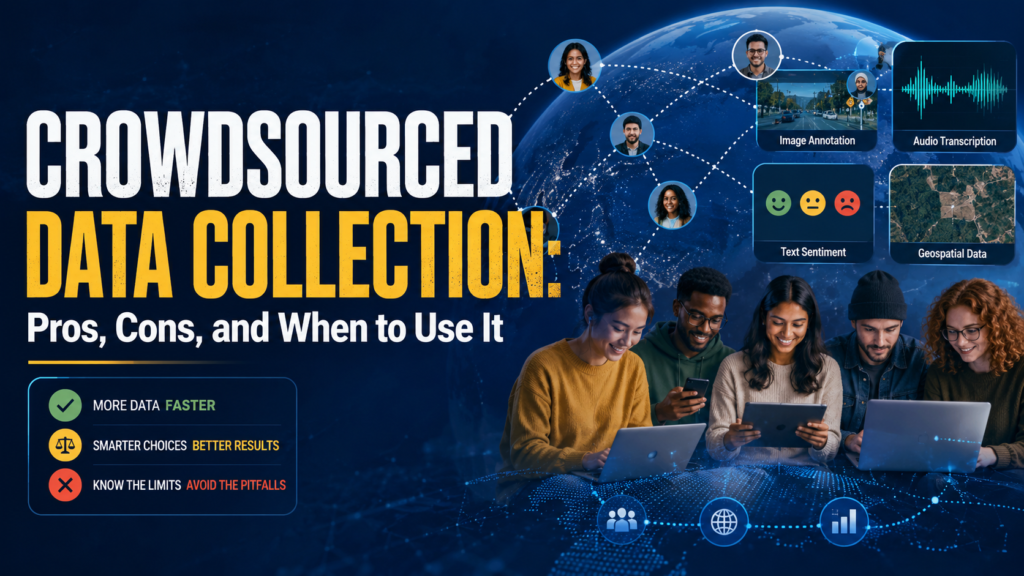
Crowdsourced data collection is a method of gathering information, labeling data, or performing microtasks by outsourcing work to a large, undefined network of people, typically through an online platform.
Instead of hiring a specialized team, you tap into the wisdom (or just the labor) of the crowd. Think of platforms like Amazon Mechanical Turk, Prolific, or even mobile apps that gamify data gathering.
The goal? To get large volumes of data quickly.
Whether it’s tagging images for a computer vision model or transcribing audio, the crowd offers a scalable workforce.
The Trade-offs: Pros and Cons
Before deciding to use crowdsourcing, it’s critical to look past the “cheap and fast” pitch.
It’s rarely that simple.
Here is the breakdown of the advantages and the hidden pitfalls.
The “Pros”: Why the Crowd Wins
Speed and Scale
Need 10,000 images annotated by tomorrow?
Crowdsourcing can accomplish this in hours, not weeks.
The parallel nature of the work is unmatched.
Cost-Effectiveness
Compared to hiring a full-time in-house team, crowdsourcing is incredibly cheap.
You pay per task.
Geographical Reach
Need data on street conditions in rural Malaysia or price points in Africa?
The crowd is already there, offering access to information and places that would be too costly for a dedicated team to visit.
Bias Reduction in Data Sources
By aggregating diverse perspectives, you can mitigate the bias that might come from a single, homogeneous research team.
In one case, researchers found that crowdsourcing platforms significantly sped up data collection for neurology studies, allowing them to gather data “from where the patients are” rather than just the hospital.
The “Cons”: The Hidden Costs of Cheap Labor
The Quality Nightmare
This is the biggest killer.
“Speeders” rush through tasks to maximize pay, often providing garbage data.
The saying “garbage in, garbage out” applies strongly here.
A study on dialogue systems found that while crowdsourcing is faster, less than half the amount of lab-collected datawas needed to reach the same accuracy for specialized tasks.
Sampling Bias
The crowd is rarely representative of the general population.
It tends to be:
- younger;
- more tech-savvy;
- geographically concentrated.
You cannot use crowdsourcing for strict probability-based sampling.
Expertise and Context
Complex tasks fail with crowds.
If you need:
- nuanced medical diagnosis;
- high-stakes legal document analysis;
…the crowd simply lacks the necessary expertise.
The “Professional” Survey Taker
There is a subset of workers who complete thousands of surveys every month.
They know how to game the system and are incentivized to provide the answer they think you want rather than the truthful one—simply to get paid.
When to Use It (and When to Avoid It)
Here is a decision matrix to guide you.
| Scenario | Use Crowdsourcing? | Why? |
| Image Classification (simple) | ✅ Yes | Great for identifying cats vs. dogs or labeling street signs. |
| Audio Transcription (clear audio) | ✅ Yes | Cost-effective if the audio is high quality. |
| Text Sentiment Analysis (simple) | ✅ Yes | Good for basic sentiment, but beware of ideology bias. |
| Seizure Detection Algorithm | ✅ Yes (for contest) | Amazing for algorithm development via competitions (Kaggle). |
| Deforestation Detection (Satellite) | ✅ Yes (with filters) | Works if you use statistical filters to remove outliers and poor-quality contributions. |
| Medical Diagnosis | ❌ No | The crowd lacks medical expertise. |
| High-Stakes Policy Data | ❌ No | Sampling bias will undermine statistical inference. |
| Highly Specialized Content | ❌ No | Poor quality defeats the purpose. |
| Longitudinal Studies | ❌ No | Attrition rates are high, making long-term tracking difficult. |
5 Actionable Strategies to Get High-Quality Data
The crowd can work—but only if you manage it correctly.
1. Filter the “Speeders”
Don’t just rely on completion time.
A groundbreaking study on citizen science campaigns found that by combining:
- outlier detection (Z-Score);
- entropy filters (removing tasks with no consensus);
they boosted volunteer accuracy by up to 20%.
2. Use Gold Standard Questions
Slip in questions you already know the answer to.
If a worker fails these “golden” tests, reject their work automatically.
3. Tailor the Instructions
Bias is real.
A project called AnNoBias found that annotators rate tweets more negatively when they disagree with the poster’s ideology.
However, simply making annotators aware of this bias in the instructions significantly mitigated the effect.
4. Test Your Platform
Don’t trust a platform’s sales pitch.
“Ensure that the platform… is well-tested.”
Run a small pilot project to check for glitches that could confuse the crowd.
5. Limit Task Complexity
The instruments used in crowdsourced data collection should be incredibly simple.
If your questionnaire contains:
- skip codes;
- conditions;
- relevancies;
you will confuse the layperson and ruin the data.
Crowdsourcing in the Wild: Real-World Case Studies
Autonomous Driving
Mobileye (now Intel) uses crowdsourced data from millions of vehicles.
They collect road data—including:
- lane markings;
- construction zones;
- road geometry—
using front-facing cameras and upload it to the cloud to build high-definition maps for self-driving cars.
Fighting Invasive Species
Crowdsorsa, a Finnish startup, developed a mobile game where players:
- take photos of invasive plants;
- remove them;
- upload “after” photos.
Players earn pocket money, municipalities receive low-cost ecosystem maintenance, and the submitted data effectively validates the completed work.
Conclusion
Crowdsourced data collection is a powerful tool, but it is not a magic bullet for lazy data scientists.
It excels at speed and scale for simple tasks, but struggles with quality and representativeness.
The secret to success lies in mitigation.
You must:
- use statistical filters;
- design tasks for ordinary users (not experts);
- acknowledge the limits of your sample.
If you need to train a model to identify tumors, crowdsourcing is a no-go.
But if you need 5,000 images of stop signs to improve pedestrian detection in rural India?
Absolutely—just watch your costs and your data quality metrics closely.
Don’t just assume the crowd is a substitute for traditional methods.